

.jpg)

Treat customer service like a cost centre, and your customers will treat your product like a commodity. We are seeing this play out firsthand as companies rush to replace their support teams with soulless AI bots and automations. The result is entirely predictable: satisfaction drops, unresolved cases spike, and management is forced into a frantic rehiring campaign to salvage the damage.
It turns out that when you optimise exclusively for cost savings, you pay a steep tax in customer loyalty. Draftable is proving that excellence requires a different playbook. By doubling down on human talent and empowering them with the best AI tools, we have pushed our customer satisfaction rating to 95+%, far outperforming the industry benchmark of 78%.
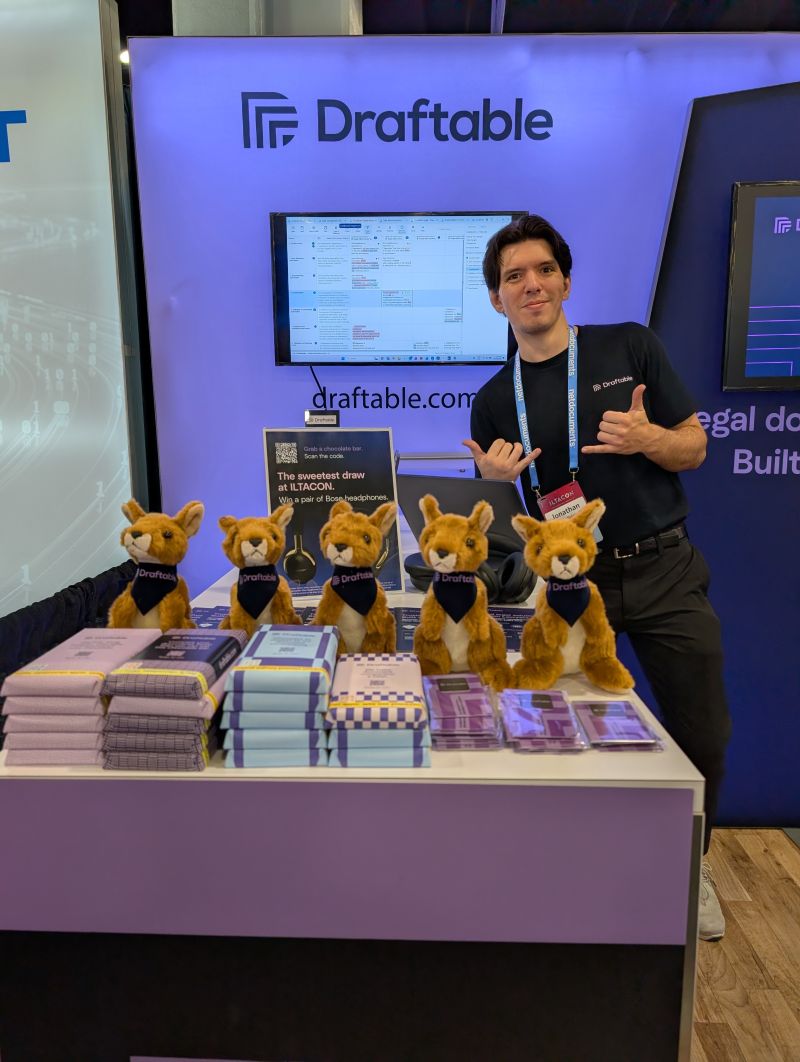
And the driving force behind that number is Draftable's Russell Ballard-Waters.
The circle of competence
People who get results share a single, obsessive trait: they know what they are good at and they play to it. Warren Buffett built an empire by refusing to invest in industries he didn't deeply understand. Roger Federer spent decades perfecting the economy of effort, cutting down the physical tax of tennis to a technique so fluid it looked completely effortless.
Russell figured out his own lane when he was in his teens. Back then, he was the neighbourhood “IT guy,” driven by a relentless curiosity for software. But he had a second trait: he liked getting to know people on a profound level. “I'm a complete lover of technology and new, emerging fields,” Russell says. “But my real passion has always been speaking to people and helping them.”
He spent his youth compounding those twin strengths, studying software engineering by day and working the phones at call centres after hours. It’s during that time that he realised the importance of hearing what customers to truly appreciate their position and offer the right support, “I got a lot of experience seeing customer frustrations first-hand and learning to understand not just the problem in front of me, but why they were frustrated in the first place.” he recalls.
His degree pointed one way; his passion pointed another. “I studied electrical engineering because I was good at maths,” Russell says, “but by the end of it I knew support was where my passion sat. I decided I needed to push myself towards the customer, because that's where I could help the most.”
When he joined Draftable as our first Customer Support Representative, it was the ultimate convergence of his strengths. The role enabled Russell to thrive by doing what came naturally to him, combining deep technical acumen with a genuine empathy for the person that needed a query resolved.
Service infrastructure built for empathy
Zappos CEO Tony Hsieh famously said that customer service shouldn't just be a department, it should be the entire company. We believe that to our core and built an ecosystem where the customer relationship is protected at all costs.
This doesn't mean we are anti-AI, “Far from it” says Russell. “We actively use automation and AI to handle the heavy lifting that gets in the way of servicing someone, but we refuse to compromise on empathy.” He continues, “there is a very important connection to have as a human, to really understand why someone is having a hard time. To recognise that, and have empathy, is what creates the experience.” Customers instantly feel the difference between a solution designed to simply close their ticket and one designed to genuinely help them.
For Russell, that difference is the whole game. “A lot of customers appreciate feeling at ease,” he explains. “It's not, ‘let me fix your problem, I don't care about you as a person.’ It's, ‘how are you feeling? Why is this a problem for you? Let's get into it.’ Just a little bit of empathy changes the entire interaction.”
That philosophy even shapes who we hire. “We only bring on people who genuinely care about what they're doing and about the team,” Russell says. “The people are what really make this business.”
Orchestrating the service machine
Over the past few months, Russell has built an AI-assisted system that triages incoming tickets, drawing on a vast database of historical cases to generate a first-pass assessment. That assessment is posted as an internal note for a human to review, correct, and improve, critically providing the feedback loop that makes the system sharper over time. The same tooling can follow an entire ticket thread, suggest a next response, and even prompt the agent to run a specific test to validate their understanding of the issue. What it never does is reach the customer without human intervention.
“It is very easy to just throw a general model into something and have customers speak to that,” Russell notes. “It might be useful ten percent of the time, but the experience that customer is going to have is usually frustration, disappointment, or probably both.”
This highlights the vital distinction Russell draws between replacing people with AI and equipping them with it. In his view, the best support professionals are not handing customers off to a bot. Instead, they are using the model to reach a far better answer than they could have found alone. “I see people in this space as directors and orchestrators,” he explains, “using these models to get the best possible answer, going further beyond rather than just giving the basic one- or two-liner response.”
AI has raised the ceiling on what our team delivers, lifting response times and quality simultaneously. Most of the time, customers do not even notice the tooling is there. They just notice they got a better, faster answer from their assigned service representative.
The real cost of a false economy
To Russell, the tempting corporate move of cutting the support team and pointing customers at a chatbot strikes him as a clear false economy. “It's extremely short-sighted, and a very short-term game,” he says. “The reputational damage can be immense.” Once a support experience earns a poor reputation, it sticks for a long time, and it is slow and expensive to rebuild. At Draftable, we know the importance of protecting the thing that is the hardest to win back: trust.
The results bear that out. Across Draftable this year, negative feedback has been virtually non-existent, while a 95+% satisfaction rating keeps inching upward.
Russell points to moments like helping a customer through a complex, three-week bespoke Self-Hosted API implementation, where the customer came away not just satisfied but genuinely grateful.
“That's the reason I love this work,” Russ says. “A lot of what I do is for those kinds of interactions.”
