

.jpg)
.jpg)


Like many industries, law firms and legal teams rely on specialised trade shows to maintain awareness of what technology is available, find new vendors or alternatives to existing suppliers, and keep across broader trends in deploying and managing legal technology. At Draftable, we sponsor legal technology conferences around the world. It’s a core part of how we meet the market and maintain a close connection with our customers and the wider legal technology community. And of all the trade shows we support, the International Legal Technology Association Conference (ILTACON) is far and away The biggest.
This year’s ILTACON 2026 did not disappoint. It was the biggest ILTACON yet at 5700 attendees, and since 2023 we’ve seen unprecedented levels of venture capital investment into legal technology and the sector is changing as a result. In this post, I’ll share our summary of the firms, the vendors, the key updates and broader themes discussed on the conference (and dance) floor. Including:
- BigLaw feeling the pressure from in house clients to adopt AI technology
- The big players, their major updates and the desire to avoid lock in
- AI moving from adoption to context engineering (though no one called it that!)
- Recognising the role of Legal Software Tools in getting more from Legal AI
- How legal tech is changing now it’s the focus of the wider tech ecosystem
Let’s get into it.
Record attendees underscore the pressure law firms are under to deliver AI value to their clients
Speak to anyone making decisions about adopting legal AI (read: Harvey, Legora, CoCounsel, Protégé, Vincent, etc) and you’ll hear a common refrain: “we had to adopt it otherwise we’d be seen as falling behind”. Law firms are pretty open about the fact that they are being pressured into adopting Legal AI by their clients. One large vendor at ILTACON cited its own research showing 95% of firms had placed their AI bets and 85% said they moved on AI because of client demand.
Commentators in legal tech have been saying law firms are under threat now that in-house teams can get more leverage and high quality legal tooling with AI platforms. Products like GCAI, Flank, and others exist to offer specific legal AI software to in house teams. The more they use AI the less dependency they will have on their external law firms. This pressure may be part of what’s driving firms to send more of their team to events like ILTACON.
From the international cohort, our team saw a number of key APAC and UK firms on the ground searching for the next wave of legal tech. This included Australian firms Allens, Arnold Bloch Leibler, Collins Biggers Paisley, Gilbert + Tobin, HWL Ebsworth, Maddocks, Swaab, Lander & Rogers. And from the UK we saw RPC, Lawfront, and Irelands own Matheson reviewing the vendors latest offerings.
VC Investment and more vendors, more products and bigger marketing budgets
Since 2024, there has been an unprecedented US$9.4 billion of VC investment into the legal tech sector. Traditionally seen as a bad option for VC money, AI has made legal an attractive vertical. This is in part thanks to high profile studies from AI labs claiming that much of the work performed today by lawyers will be easily automated by AI and data showing legal users as a high proportion of ChatGPT and Claude users. The flood of money has resulted in an explosion of new legal tech providers with more sophisticated and compelling marketing. Harvey famously used dark lighting photography to make legal tech look cool. Now everyone is following suit.

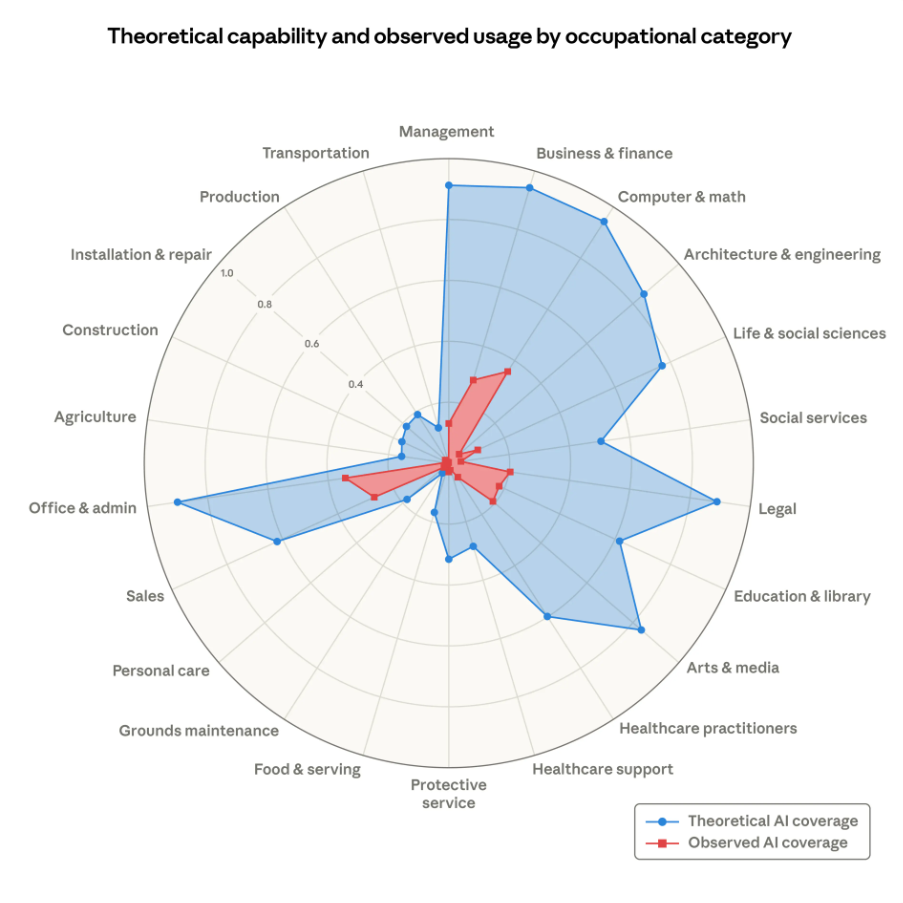
Figure 1: Theoretical capability and observed exposure by occupational category
Share of job tasks that LLMs could theoretically perform (blue area) and our own job coverage measure derived from usage data (red area). Original study by Anthropic available here



Beyond the evolving aesthetics, the other manifestations of the VC money were in the scale of vendor booths and paid advertising around the event. Harvey had their “Harveyworld” – a series of booths built into several large fully contained rooms, including a shopfront where any merch could be “purchased” free of charge1. Harvey also ensured they were inescapable. Stepping off a flight at Nashville’s BNA airport and while waiting to pick up luggage attendees were bombarded with their ads. Likewise, Harvey ads were seen on screen while waiting to catch an Uber ride from the hotel or even on billboards around the event.

Figure 2: Images of the Harvey and Legora booths at ILTACON 2026, photo courtesy of Sarah Glassmeyer, director of data curation at Legaltechnology Hub.
Legora spared no expense with an equally impressive and massively sized series of booths. They ran a café service with barista coffee all week for attendees (so did Clio by the way). Legora’s shuttle buses toured the city non-stop, meanwhile their private event custom furbished an entire downtown bar with Legora branding (including branded pool table felt!) and hired Sheryl Crow for a private performance to wide acclaim.
Lesser-known names in the new wave of legal tech had also clearly been raising money and deploying a lot of it to capture attention. An AI named LOIS was everywhere. For a name that few would have known just two years ago the branding was inescapable. But what is LOIS? At a glance, it’s another agentic legal AI platform promising to know the law well enough to be reliable. The product is by FileVine – a plucky startup founded in 2014 that had a small booth at last year’s ILTACON but has exploded after a $400m fundraise in 2025. This year, it delivered a sea of green across the event. Everyone we spoke to was saying “WTF happened with FileVine?” with many still unsure what they do. And a special mentions go to Elite who brought a branded Lamborghini on to the vendor exhibit floor (and yes, it was driven away on the last day).

Figure 3: The team at ELITE were not about to let Harvey and Legora steal the booth extravagance without a fight, bringing a branded Lamborghini to the exhibit floor. Photo courtesy of ELITE.
Large company updates: New designs & new models
While AI has meant that there is more money for legal tech and more marketing, the substance behind those campaigns is real. ILTACON 2026 saw significant announcements across the large and small vendor ecosystem.
Starting large, iManage previewed its ‘next-gen’ platform upgrade. Pitched as enabling a better experience with AI at its core and leveraging the data in the DMS, the team at iManage have clearly been talking to customers. Their changes include a personalisable home screen, the ability to automate matter overviews, improved natural language search to collect and ultimately build first-pass documents from historical context in and outside of matters. NetDocuments and LexisNexis both continued to preview and promote their own user experience and AI feature updates, some of which had been previewed earlier this year.
Harvey dropped its Harvey II platform announcement right before the conference began. The big change is ‘memory’ – a feature that promises so much (think context engineering without the work involved) but has remained elusive and ultimately unsolved by all AI providers including the major labs. Many attendees we spoke to were sceptical about how much of an impact it was going to have. Harvey also announced it is post-training its own model Tenet but that announcement seemed less exciting to attendees than Thomson Reuters own news that it had built a legal AI model, Thomson, on top of Qwen and published it to Hugging Face. Both vendors were claiming these investments were about improving performance, but most seemed to interpret this as a mechanism to reduce cost to serve as the platforms move to usage based pricing and token costs rise (especially for Anthropic’s Claude models which have been preferred by the legal industry over the last 12 months).
Small company updates: More features, quality data and MCPs for AI context.
Meanwhile, smaller established legal tech vendors are using AI to ship more features than ever – with a clear focus on defending their market share from AI platforms and bigger players. The keywords found at most smaller booths this year were ‘data’ and ‘MCP’ (model context protocol). The recurring narrative observed on the exhibit floor was that software tools hold important context that firms need in their AI workflows. That data makes AI more reliable, more effective and therein lies the enduring value of the providers against the AI wave washing over the sector. We also saw ongoing investment into Office 365 (modern JS) integrations from vendors, with attendees commenting that if vendors don’t have a plan for replacing older Microsoft Office (COM) integrations, they aren’t going to continue being used by the firm.
More broadly, every smaller vendor we spoke to seems to be getting asked the same question – “won’t AI replace you?”. And in response many are either adding AI into their products or integrating with legal AI platforms and emphasising the value of their deterministic tools in the future of legal AI work. Our conversation with the team at DeepJudge highlighted this exact phenomenon. Their popular enterprise search algorithm is preferable to LLM-powered search because of its ability to find better results faster across a large number of data sources in much less time and at far less expense2. Draftable’s recent work exploring AI vs non-AI comparison also highlights this same trend in the context of document comparison and redlining workflows. Most vendors we spoke with raised this distinction between deterministic tools and probabilistic large language models and we left thinking it won’t be long before the industry settles into a more balanced ecosystem with both software tools and legal AI platforms.
All of the above means that most legal SaaS providers AI strategy is centred around building MCPs that integrate with the major AI platforms (read Harvey, Legora, CoCounsel, Claude, Copilot, etc). Expect to see more of those announcements over the next year.
The pressure on project teams isn’t going away any time soon
The impact of all we’ve discussed is that the pressure for IT project team attention is increasing. We are seeing more legal-specific AI models, more software feature releases powered by AI-enabled product development, and new vendors with bigger and more engaging marketing campaigns. For the project teams that run technology pilots (or proofs of concept) and then manage deployments, there is a pervasive sense of burnout from the last 3 years. Several attendees named bandwidth as a key limitation. And while there seems to be an emerging recognition that these teams will need to grow to meet the demands of the AI era, getting approvals to hire new staff and then filling those positions remains a challenge.
This means legal tech vendors will increasingly have to do more to convince firms that their products or new features / releases are genuinely “pilot-ready”. Otherwise they’ll find there’s no time available for their projects.
Looking at how this is playing out, one example is in iManage’s decision to allow firms to rollout its “next generation” platform redesign at their own pace rather than forcing it like the Work 10 / cloud migrations which soaked up a year of project capacity for many firms. There was audible sighs of relief when iManage’s Director of Product Management Ravi Lal acknowledged the pain of the Work 10 migrations back in 2024-25.
Where are we going from here? The next 12 months in legal tech and AI
The big picture theme at this year’s conference was the combination of AI fatigue among firms and the need to continue on the AI journey. The focus is clearly moving away from adoption of AI (with almost all firms using Copilot and a legal specific AI provider like Harvey or Legora). The discussion has now moved to getting the ROI from those investments, especially in the face of usage-based pricing models. That requires one thing: context engineering. The idea that to get the value from AI, it needs to understand how organisations, teams and individual lawyers work – their data, their workflows, their preferences and communication styles. This is something the wider AI scene has been grappling with for well over a year. Harvey may have just released its memory feature to try and provide automated context engineering for its users, but ChatGPT made similar moves well over a year ago with limited success. Most power users of AI are getting value off the back of long term and consistent efforts to build context to how they work in increasingly sophisticated markdown-based knowledge systems (see Andrei Karpathy’s LLM knowledge wiki for an example of how deep this can go). Expect firms to be working on this more in the next 12 months, with new teams being formed around knowledge management, governance around firm context / plugins, standardization of tool use inside of Legal AI workflows and similar.
And even with investment into knowledge management for context engineering, we’ll continue to see AI failures as we discover what the technology is ultimately unable to do well. Several firms we spoke to at ILTACON had visited the major AI labs prior to the event, including Anthropic, OpenAI and Google. And they were reportedly briefed on their current view of the so-called jagged frontier of AI and which ‘repeating tasks’ in legal work could be completed by AI (and which ones could not). This underscores the reality that as of today, lawyers will be augmented by AI rather than wholly replaced (as is the case with more or less every job). And while many tasks have been automated by AI, the legal sector will continue to find it very hard to wholly shed dependence on headcount – human lawyers will be needed because lawyers need certainty and accountability when providing legal advice.
