



.jpg)
.jpg)
Download the complete open-source legal tech inventory here
One of the most exciting things about AI is that it has allowed anyone to build software solutions for their unique needs. Subject matter experts are now able to build products that would have taken technology teams years to build. In many cases, people are building tools that are completely unique to their needs or serve a need so niche there wouldn’t be a big enough demand to justify a commercial product. In the legal industry this is having a huge impact. Practicing lawyers are building their own legal tech products.
At Draftable, we’ve been observing (and cheering) this trend for over a year, and at the start of this year we decided to start tracking it. Now, we’re publishing our ‘open source legal technology inventory’.
How lawyers building tools took Legal Tech by storm
Open-source legal products have been around for a long time. But AI has radically changed this space in the last 12 months. The legal tech LinkedIn community started taking notice of open source when former Clifford Chance Senior Associate Jamie Tso started going viral posting his ‘clones’ of prominent legal tech products he’d been building over his weekends and evenings. His post from January 2026 showing Google’s Gemini 3 building a clone of Harvey and Legora’s tabular review feature received over 1,700 reactions, 211 comments and 98 reposts. Not bad for a mid-level funds lawyer working out of Hong Kong. The response he received set a fire. Tso posted more open-source clones he’d built, started doing podcasts and began sharing how he was building with others. Meanwhile, other tech-enthusiast lawyers building software with AI began to coalesce around him. More open-source legal tech was being released by others and amplified by Tso. Then the big moment came. In May 2026, former Latham & Watkins Associate Will Chen went viral posting that he’d built an open-source alternative to Harvey and Legora in two weeks. His tool MikeOSS has 4,200 stars on GitHub and 1,300 forks (where others have built their own products on top of his work). Chen and MikeOSS got mainstream press coverage. The virality of Tso and Chen inspired others. Nick Watson released doc.haus, an open-source legal AI agent. Kevin Keller released Donna, an app with features like chat, legal research, tabular review, matters, knowledge bases and workflows using skills, redlining, and automations. The floodgates were well and truly open.
Open-source legal tech – by the numbers
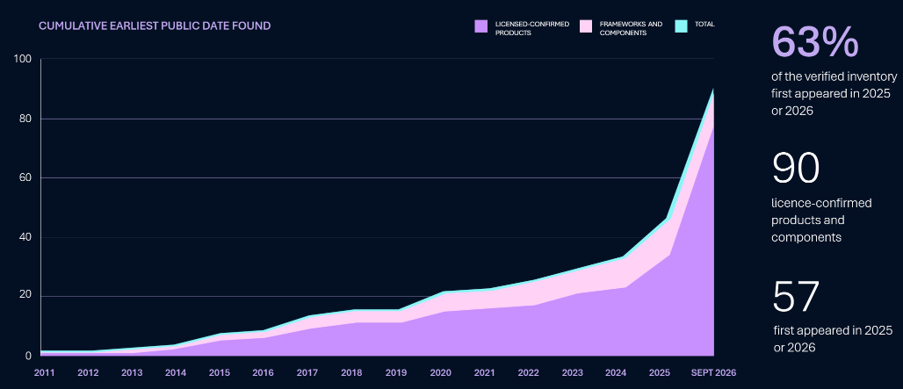
Our research into Open-Source Legal Tech focused on the current wave, but our work found projects dating as far back as the FreeEed eDiscovery product by Mark Kerzner in 2011. Importantly, our inventory quantified the explosion our team had bee witnessing in open-source legal tech since the beginning in 2025. The results found 63% of all open-source tools in the inventory were released in 2025 and 2026, with the growth rate steeply accelerating.
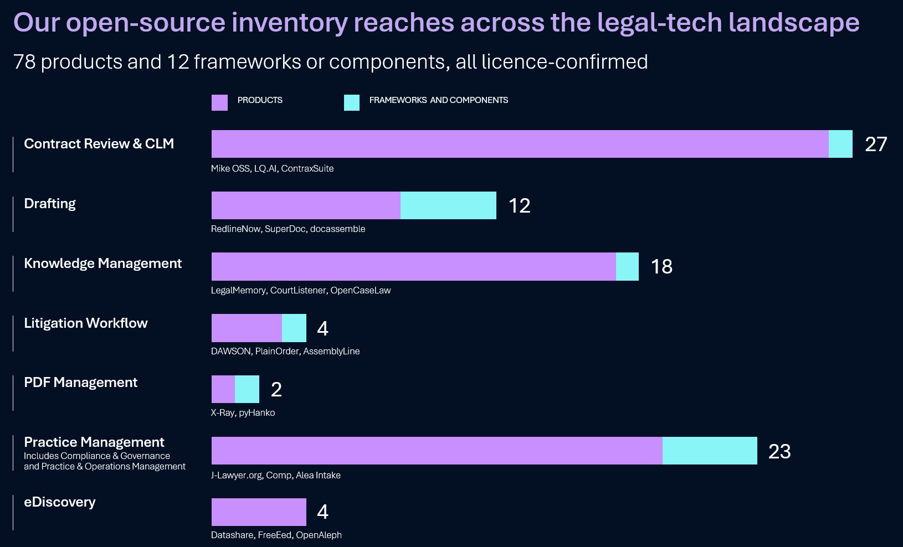
Looking at those releases in more detail, we evaluated each to categorize it using Draftable’s own internal legal tech taxonomy we developed to track the industry landscape. Our classification analysis found the majority of open-source tools fell into two categories: contract review and practice management. From our perspective this makes a lot of sense. You only need to have walked a legal tech trade show floor in the last 12 months to have seen that contract review is the biggest area of AI product competition in the commercial vendor space. And practice management captures all the individual productivity workflows that have been developed and released as open source. We’ve certainly seen internally at Draftable that when individuals learn how to use agentic AI, they tend to begin by building apps that help their own personal productivity and admin. In legal tech, much of that will fall into ‘practice management’. Other notable areas for open-source releases were in Drafting and Knowledge Management.
When the LinkedIn posts became an ecosystem
Open-source building isn’t unique to legal tech. Many players across the AI and corporate worlds have been investing increasingly in open-source AI and application infrastructure. Examples like Ollama for running open source AI on local infrastructure, continuing releases of open-weight AI models like Kimi K3, Qwen and GLM 5.3 all contributed to the sense that you could not only build your own apps, but increasingly power them with open-source models hosted on your own hardware. Likewise, many of the open-source releases weren’t legal tech apps themselves, but rather building blocks that could be used by others to build their own legal AI applications. Docxodus offered a way to render Word documents inside a browser and even run redlines of them. LexNLP provided information retrieval and extraction for unstructured legal documents. Much like with commercial software, the release of these ‘building block’ libraries made it even easier for the vibe-coding lawyers to use their subject matter expertise to build workflow-aware applications on top of those libraries.
A community of builders
While the releases kept on coming, Tso was searching for what to do next after having left Clifford Chance. He and others around him began building the start of a community around legal open source. What started as a private WhatsApp group led to the formation of LegalQuants – an organization founded by Tso and several others to find, vet and train what they call ‘legal quants’. These are lawyers who believe they can bring the same quant trading ethos from trading firm Jane Street to modern legal practice. Other groups such as vibecode.law(started by people behind Legal Tech Collective, Tacit Legal and Lupl) were formed to help non-developer lawyers build their own solutions with AI.
Making use of open source: advice for law firms and legal teams
The open-source landscape in legal tech is growing rapidly. And as they say, quantity has a quality all of its own. And so regardless of the view of open-source legal tech a few years ago, it’s clear this space needs to be monitored and positioned for. In a world where tech-enthusiast lawyers can build their own legal tech, it’s worth assuming there will be some valuable innovations coming from outside commercial vendors.
For law firms and legal teams, this means the first step is to pay attention. And to help with that, we’re publishing our open-source legal tech inventory. This resource compiles open-source legal technology products, classifying them into legal tech product categories using our own internal taxonomy of the landscape. We provide an indication of which commercial products the tools overlap with, licensing information (where available), and include links to both release details and GitHub repositories. We’ve also classified the tools as either software or legal tech infrastructure. Our hope is that this can serve as a useful starting point for getting familiar with the space.
Beyond being aware, we see open source as offering value to legal teams where one of the following statements is true:
- There is a real need for a solution and no suitable commercial offering
- There is a paid solution in place at high cost or risk, and an open-source alternative could address those issues
- There is a need for something new, and an open-source solution offers a potential starting point
Generally speaking, we see open-source legal tech as strongest in narrow and low-volume use cases where the market offerings are thin or non-existent. Where individual lawyers or practice areas want bespoke solutions that fit their particular needs, it’s less likely a commercial vendor has a good option given the market for that product would, by extension, be small.
Another scenario where open source can be useful is in rebuilding or replicating a more widely used commercial tool in house. In these cases, open source may simply be used as a source of inspiration for internal teams building something themselves. Or where suitable, open source can be a starting point that is ‘forked’ (copied and built on top of), saving time on basics. Indeed, most commercial software is built this way.
What to look for when you’re looking at open source
While by no means exhaustive, below is a short list of what to be considering as part of an evaluation of any open-source tools or libraries prior to use:
- Licensing – what are the legal allowances around its use? Can you modify it and redistribute it on your own terms?
- Edge cases – does it work on non-standard documents or workflows? Often these tools are built quickly and for the ideal scenario. But working in production means they need to work all the time, not some of the time.
- Code quality and security – vibe-coded apps can famously consist of “slop”. Always have an actual software engineer or programmer review the code and give you an evaluation of its quality (hint: AI can help with this!). It’s also critical that it be reviewed for security vulnerabilities as per proper protocols.
Where open source shouldn’t be used
While there are plenty of opportunities for open source, there are clear patterns to where these options make far less sense for a commercial legal team or law firm. The most obvious of these is in use cases where customer support from vendors is considered essential. Open-source tools are maintained by community volunteers. You will have no guaranteed customer support. Unless your IT team plans on taking on that responsibility directly, think twice before replacing a paid tool with an open-source option. The same goes for tools that require upkeep and maintenance. It can be genuinely fun to build new software, but maintaining it is a never-ending job and often far less creative or rewarding. Non-professional developers like AI-enabled lawyers are even less likely than software engineers to enjoy or be bothered doing this type of work.
Looking ahead: technical teams and the risk of relying on AI software vendors
Open source is growing. And there will be value to leverage in the space for firms and in-house legal teams. But to do so, legal organizations will need more software engineers / developers as specialist resources who can help evaluate the risks and help build on top of those tools. Likewise, teams will want to attract tech-enthusiast lawyers and train them to act as their own internal builders (working with the guidance from those technical experts). That structure allows organizations to incubate their own innovative legal tech products internally that enhance their existing IP and ways of working. And that is becoming more and more important as we discover the limits of privacy and confidentiality among AI vendors.
The case of OpenAI and the mathematicians’ work
On the 9th of September 2026, OpenAI shared that it had used itsGPT-6 Astra model to find a solution for the Navier-Stokes Millennium Prize Problem. The fact that frontier AI can identify a solution to long standing challenges in mathematics was not new. This was the latest in a series of announcements from OpenAI, Google and Anthropic sharing breakthroughs in mathematics using their AI models. But in this case, the breakthrough has underscored the increasing IP risks to businesses that rely on AI models managed by external vendors. Specifically, two mathematicians (Levent Alpoge and Tristan Buckmaster) had been using ChatGPT to work on the same problem. Alpoge and Buckmaster accused OpenAI of using their work to train the model and help to solve the problem. In response, OpenAI stated “while unlikely, we cannot rule out that de-identified data derived from their usage of our products helped improve our models”. In response to this acknowledgement, prominent technology investor and former Facebook Senior Executive Chamath Palihapitiya advised on the All-In Podcast that:
“If you have very sensitive proprietary data, you have to make a very difficult decision because the reality is something is leaking. There is remnant memory… …that sits in the models even after the fact….
…There’s all these vectors where this data leaks into the broad corpus and understanding that these models have….
If you believe that the information that you have is critically important, you cannot use these services the way that they’re currently offered by most people.”
The incident has been the latest to highlight that there are genuine risks to any business that shares its internal IP with AI vendors via their software tools. Many in the AI industry, such as Palantir CEO Alex Karp and NVIDIA CEO Jensen Huang, have publicly advocated and advised that businesses adopt so-called ‘sovereign AI’ using open-source models. These are AI products that run all internal ways of working, IP and proprietary data on open weight or open-source AI models that run on hardware owned and stored by the organization. In many ways, this approach is the same as the on-premises software options law firms preferred in the past. High-profile firms such as Kirkland & Ellis and Latham& Watkins are investing hundreds of millions of dollars building their own AI solutions for precisely this reason. The question is, what is everyone else going to do?
